


HonestHustles Mission
HonestHustles helps people find legitimate ways to make money online through honest, hands-on reviews. We cover side hustles, online tools, paid-to-play platforms, and real earning opportunities without hype, fluff, or false promises.Every review is built around one simple question: Is this actually worth your time and money?We focus on what works, what it costs, and what to avoid.
Real Work in ProgressThis site is built and updated in real time, not quietly polished behind the scenes. That means you might occasionally run into a bug, broken link, or feature that is still being dialed in. That is part of the process.
Everything here is tested, improved, and pushed forward continuously to build something genuinely useful, not just something that looks finished.If you run into an issue, feel free to reach out. Feedback helps improve everything faster.







Reviews
Real Experiences Real Reviews.
Meta Verified Premium Support — I Actually Needed It. Here's What I Got.
💬 Mostly HypeIn May, my Facebook account of nearly two decades was hacked.
The attacker logged in from a commercial VPN datacenter, uploaded a forged ID file, and walked away. They didn't post anything. They didn't message anyone. They didn't try to scam my contacts. The entire attack lasted minutes, and the only action it took was uploading one file specifically designed to trigger Meta's automated enforcement system.
Eight seconds after Meta's AI reviewed that fake ID, my account was permanently disabled.
Eight seconds. No human looked at it. No notification was sent to me about the foreign login. No email asked whether I'd uploaded an ID — because I obviously hadn't. The hacker never had to log in a second time. They didn't have to. They had figured out that Meta's automated system would do the rest of the damage for them.
I had paid for Meta Verified at the time — Meta's premium subscription tier that explicitly promises priority support and impersonation protection. This is my honest review of what that money actually bought when I needed it most.
What I Actually Lost
Before the review part, the inventory of what disappeared:
- Nearly twenty years of posts, photos, and history on my main Facebook account
- 7,800+ followers across multiple business pages — My Tiny Home page, My Funny Farm page, the pallet projects page, My Scrap Removal business
- My Instagram account
- WhatsApp and WhatsApp Business access
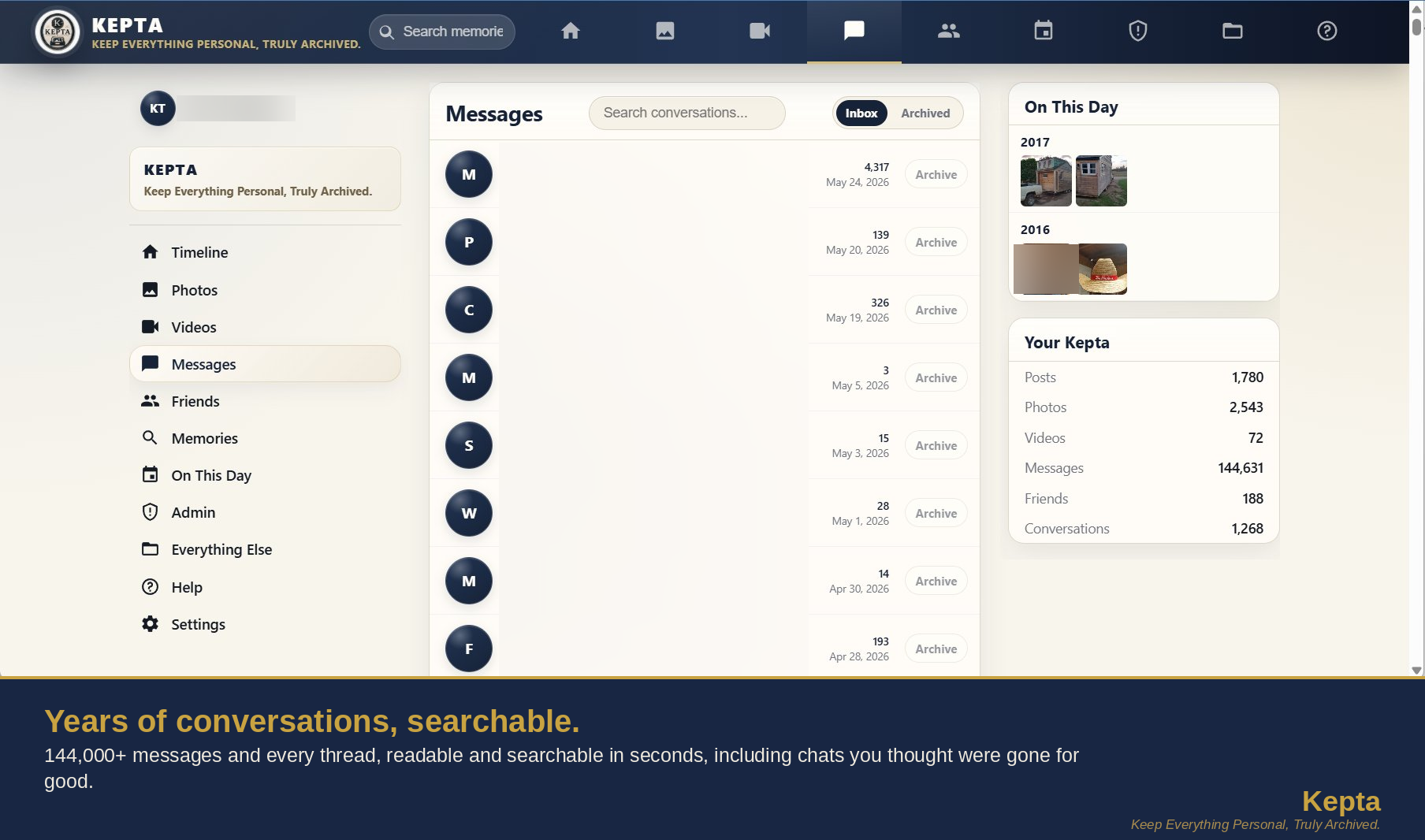
- 144,631 personal messages
That last number deserves a moment. Some of those messages were conversations with my late son and my mother. Followers can be rebuilt. Business pages can be remade from scratch. Conversations with people who aren't here anymore can't.
That's what was at stake when I went looking for the "premium support" I was paying for.
What Meta Verified Promises
Meta Verified is sold for $14.99 a month on mobile and $11.99 a month on the web for individuals (Canadian pricing similar; check current rates as Meta adjusts them periodically). For that, you're supposed to get:
- A verified blue badge
- Proactive impersonation monitoring
- Priority access to support — real humans, faster response
- Some increased visibility in feeds (Meta's wording is intentionally vague here)
- Bonus stickers and creator tools
The first two badge-and-monitoring features sound nice. They're not why most people actually buy this thing. The real reason most people pay $14.99 a month for Meta Verified is the third item: access to real humans when something goes wrong.
That's the promise this review is about.
What Actually Happened When I Used The Support
I won't bury the lede. Here is every channel I tried, in order:
- The official
facebook.com/hackedrecovery form. No response. Ever. - Emails to Meta's published security addresses (
phish@fb.comand the Instagram equivalent). No reply for weeks. - The Meta Verified support chat — the whole reason I was paying. Got shuffled between three different agents over three days, each one apparently reading from a script and confused about the basics of my case.
- Provided the correct account IDs multiple times. Support agents kept investigating a different account I'd created years ago for an unrelated reason. I corrected them. They went back to investigating the wrong one anyway. Weeks of this.
- The "specialized team" escalation. An agent told me I'd be called back with updates. I never got the call.
- The dedicated recovery email Meta linked to. Account was already flagged "DISABLED" with no path forward.
- A help link Meta's own support sent me. Returned a 404. The link Meta's support team handed me to fix my problem was a dead URL.
- A second account to try to investigate from inside the platform. Meta's support then confused that account for my main one and investigated the wrong one all over again.
- A new personal account, started from scratch. Within hours, throttled. Maximum ten friend requests per day. One marketplace ad allowed. Treated like I was the suspected attacker.
Total channels attempted: nine. Total channels that resolved anything: zero. Total time on phone with Meta's "priority support": measurable in hours.
Meanwhile, Meta Verified will continue bill me Every month. For protection that hasn't worked, and support that wasn't supporting.
The Eight-Second Problem
The single most damning fact in this whole story is the eight seconds.
Meta's AI completed its review of the forged ID at one specific timestamp. Eight seconds later, my account was disabled. That means no human ever reviewed the case. No human could have. The decision to permanently disable an account containing nearly twenty years of personal and business history was made entirely by automation, in less time than it takes to read this paragraph.
Meta had all the evidence to know this was a compromise:
- The login came from a commercial VPN datacenter overseas — not a residential connection
- The login tool was an automated script, not a normal browser
- Geographic impossibility (a session originating in California, while my real sessions came from Canada within minutes)
- The forged ID itself was, technically, evidence of forgery — which Meta's AI literally flagged
The system looked at all of that and chose to ban the account holder. Not the bot.
Meta's enforcement system runs in seconds. Its appeals system runs in weeks, or never. That asymmetry isn't a glitch. It's the design.
Why "Premium Support" Couldn't Help
I had to think about why the support tier I was paying for couldn't actually do anything. The answer turned out to be structural, not personal.
The agents you reach through Meta Verified don't have account-recovery authority. They're contractors, often outsourced overseas, working from scripts. They can read your case, sympathize with it, escalate it. They can't act on it. The tier of Meta employee who can actually unlock an account is a tier you can't reach by paying $14.99 a month.
So what does the $14.99 buy you?
It buys the appearance of recourse. A real human picks up the phone. Notes get taken. Cases get escalated. None of it can actually fix the problem because none of those humans have the authority to fix the problem. It's structurally a customer-service theater.
To borrow a metaphor that came up while I was thinking this through: you paid for a fire alarm and a fire department. When your house caught fire, the alarm didn't go off. The fire department locked their doors when you arrived. Then they sent you a bill for next month.
I Cross-Checked My Story Against Three AI Systems
Before publishing this review, I wanted to make sure I wasn't just an angry user misreading what happened. So I walked the whole timeline through three independent AI systems — including, notably, Meta's own AI assistant — and asked each one to analyze what had occurred.
All three reached the same conclusion, independently, with no coordination between them: Meta's automated enforcement system failed to distinguish a compromised user from a bad actor, and Meta's support infrastructure was incapable of correcting that mistake after the fact.
The most telling response came from Meta's own AI. Given the technical details — the bot fingerprint, the VPN datacenter origin, the impossible travel between cities — it laid out the case against its own parent company in more forensic detail than any human Meta employee ever did. When the company's own AI is calling the enforcement system "automated entrapment," that's not a user complaint anymore. That's a structural diagnosis.
What About Regulators?
A fair question someone might ask reading this: doesn't Canada have privacy regulators that are supposed to handle exactly this kind of situation? The Office of the Privacy Commissioner of Canada (priv.gc.ca) does exist, and they technically have authority over how companies handle Canadian users' personal data under PIPEDA. You can file a complaint for free.
Here's the honest version of what that gets you: a file gets opened. An investigation may eventually happen. A finding may eventually be issued. Whether any of that has a real effect on a US-based trillion-dollar company over one Canadian user's locked account is a different question, and the realistic answer is: probably not. Canada isn't going to discipline Meta over me. Meta isn't going to send an apology email and reinstate the followers. I'm one very small itch on a very large company.
If enough affected users filed complaints at once, maybe the cumulative pressure would move policy. Maybe. But banking on a regulatory rescue is structurally the same mistake as banking on premium support — you're handing your fate to someone else and hoping they care about your problem more than they actually do.
That's why this review doesn't end with "file a complaint and wait." It ends with the only thing in this whole story that's actually under my control.
The Honest Review of Meta Verified Premium Support
Do not pay for Meta Verified expecting it to help you recover a hacked account.
That's the bottom line. Everything else is detail.
If you specifically want the blue badge for credibility purposes, fine — that part of the product technically works. If you're paying because of the support tier, save your $14.99 a month. You are buying the appearance of recourse, not actual recourse. When you need the support, you will discover it isn't really there.
The most useful thing $14.99 a month buys you is a strong feeling, right up until the moment you need anything other than a strong feeling.
What I Built Because of This
After I exhausted Meta's recovery channels, the question I had to answer wasn't how do I fight harder for the old account. The old account was gone. The real question was: how do I make sure I never have to fight that fight again, for anything else I care about?
The answer is what I've been building since the disablement. It's called KEPTA Keep Everything Personal, Truly Archived..
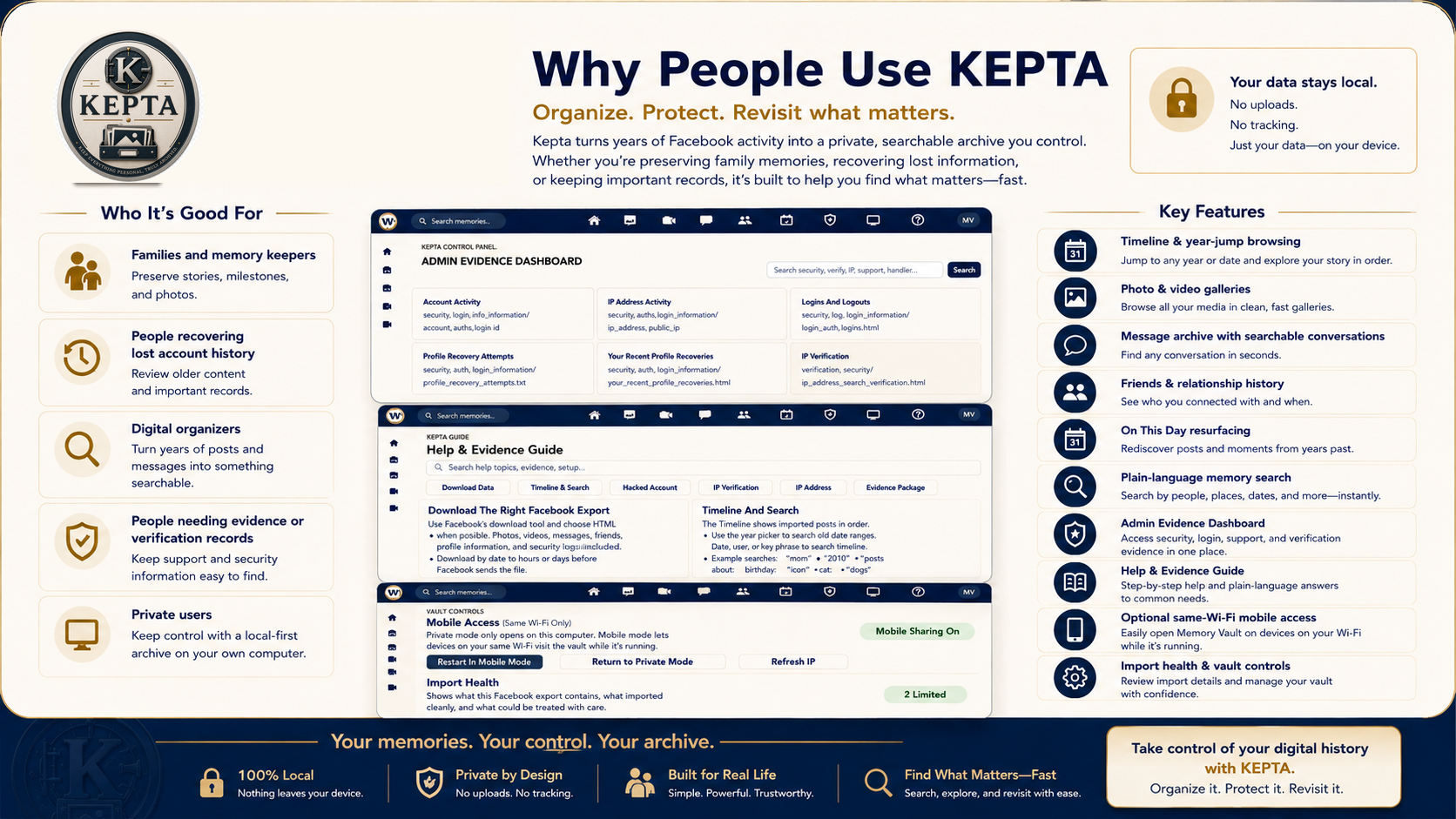

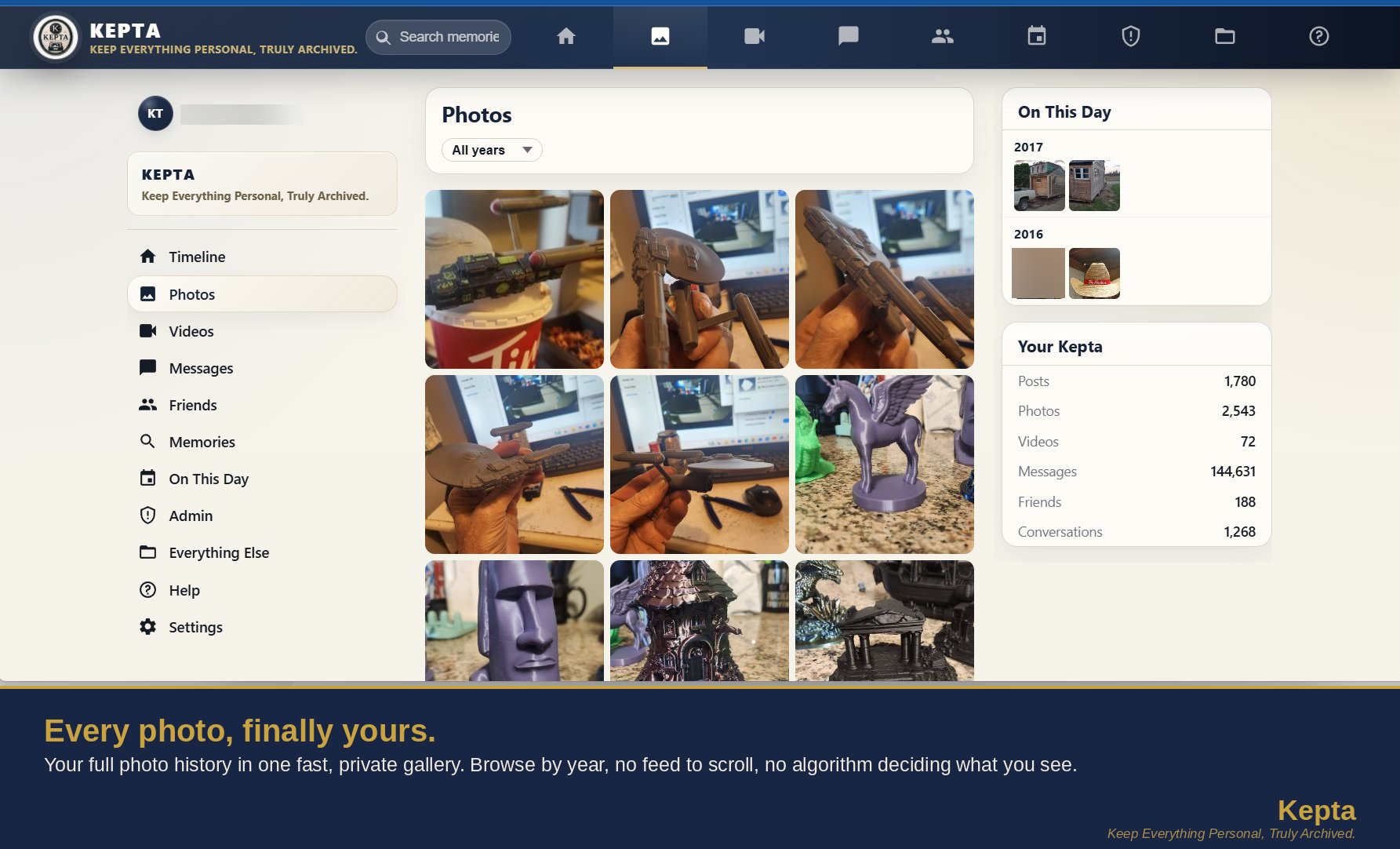
KEPTA is a personal archive that takes your Facebook data export — the one Meta is legally required to let you download — and turns it into something you can actually use. Browseable timeline. Searchable photo library. Conversation threads you can read again. "On This Day" memories pulled from your own years, not Meta's algorithm. SI-powered memory search where you can ask things like "what was I doing in March 2018" and actually get an answer.
Everything stays on your computer. Nothing uploads to a server. Meta can't disable it, can't lock you out of it, can't change the terms of access. It's yours, the way the original photos and conversations should have been from the start.
I built it because I had to. I'm sharing it because if Meta did this to me, they will do it to other people, and at least some of those people have memories they can't afford to lose either.
What KEPTA Actually Does
Quick tour of what's inside:
- Timeline: every post, photo, and check-in from your Facebook history, in chronological order, instantly browsable
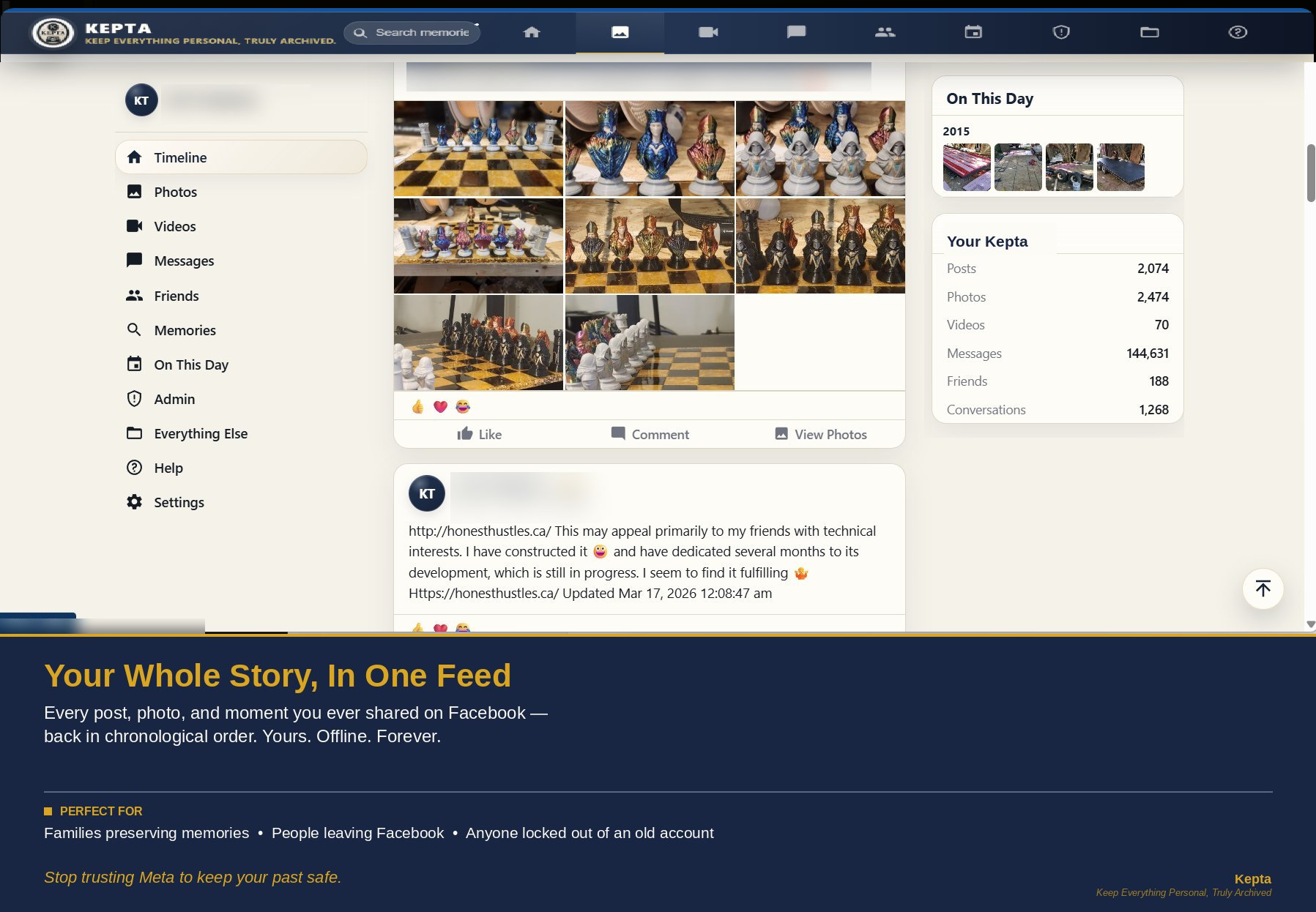
- Photo Library: every photo you ever uploaded, filterable by year, friend, or place
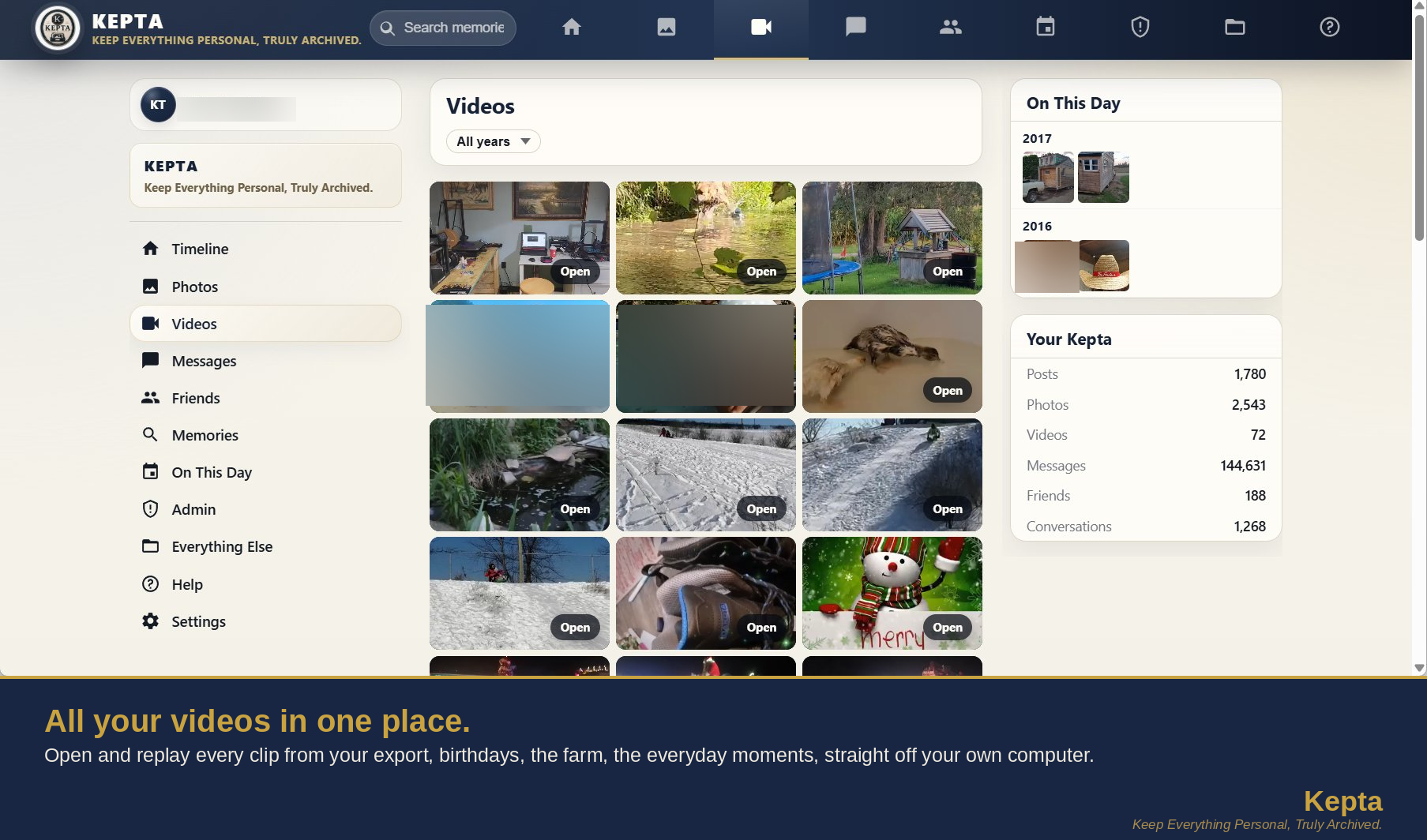
- Video Library: every video, restored and playable
- Messages: every Messenger thread — in my case, 144,631 of them — fully searchable
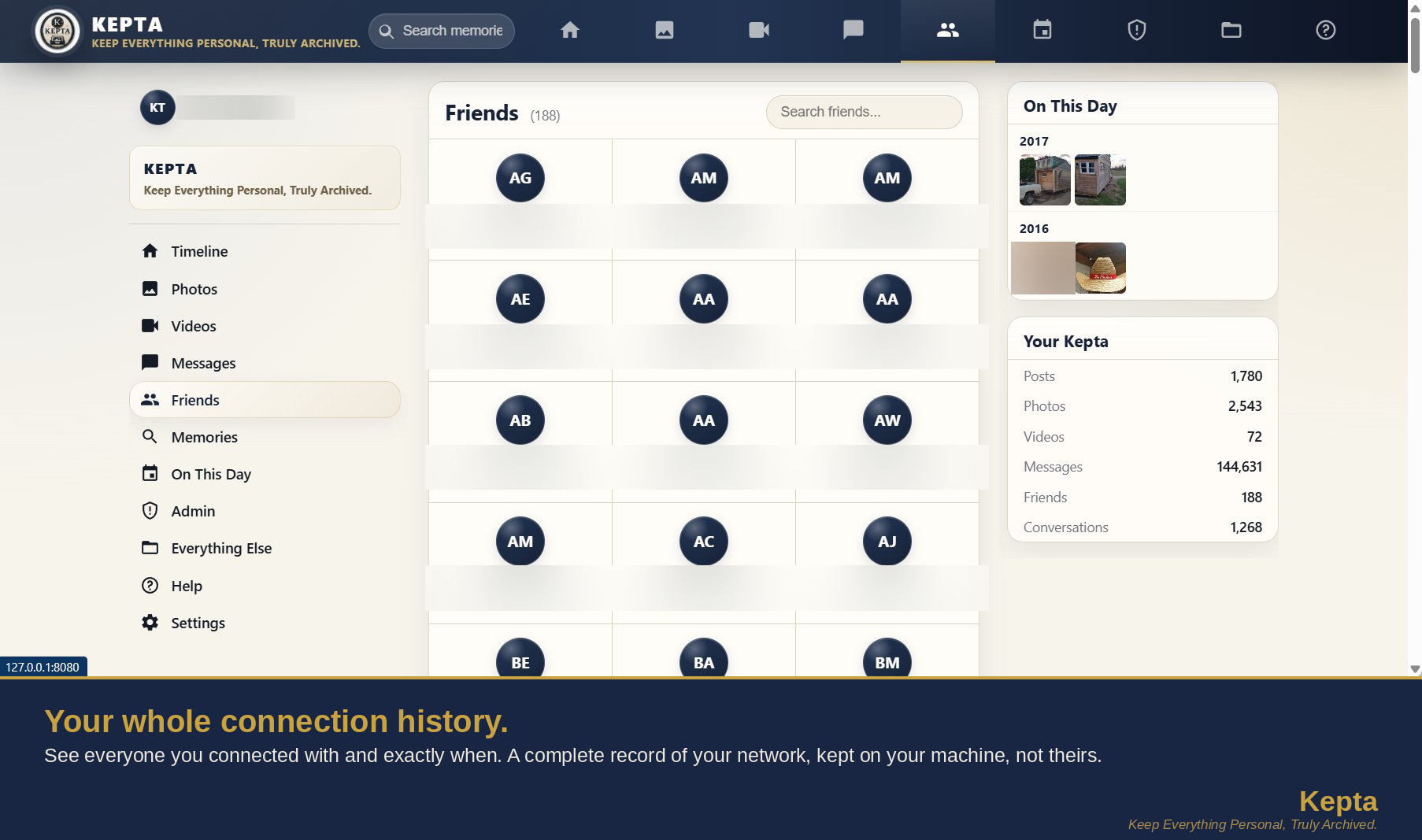
- Friends: your full connections list with the dates you became friends, the way Facebook records them but rarely shows them to you
- On This Day: daily memories from every year you've been on the platform
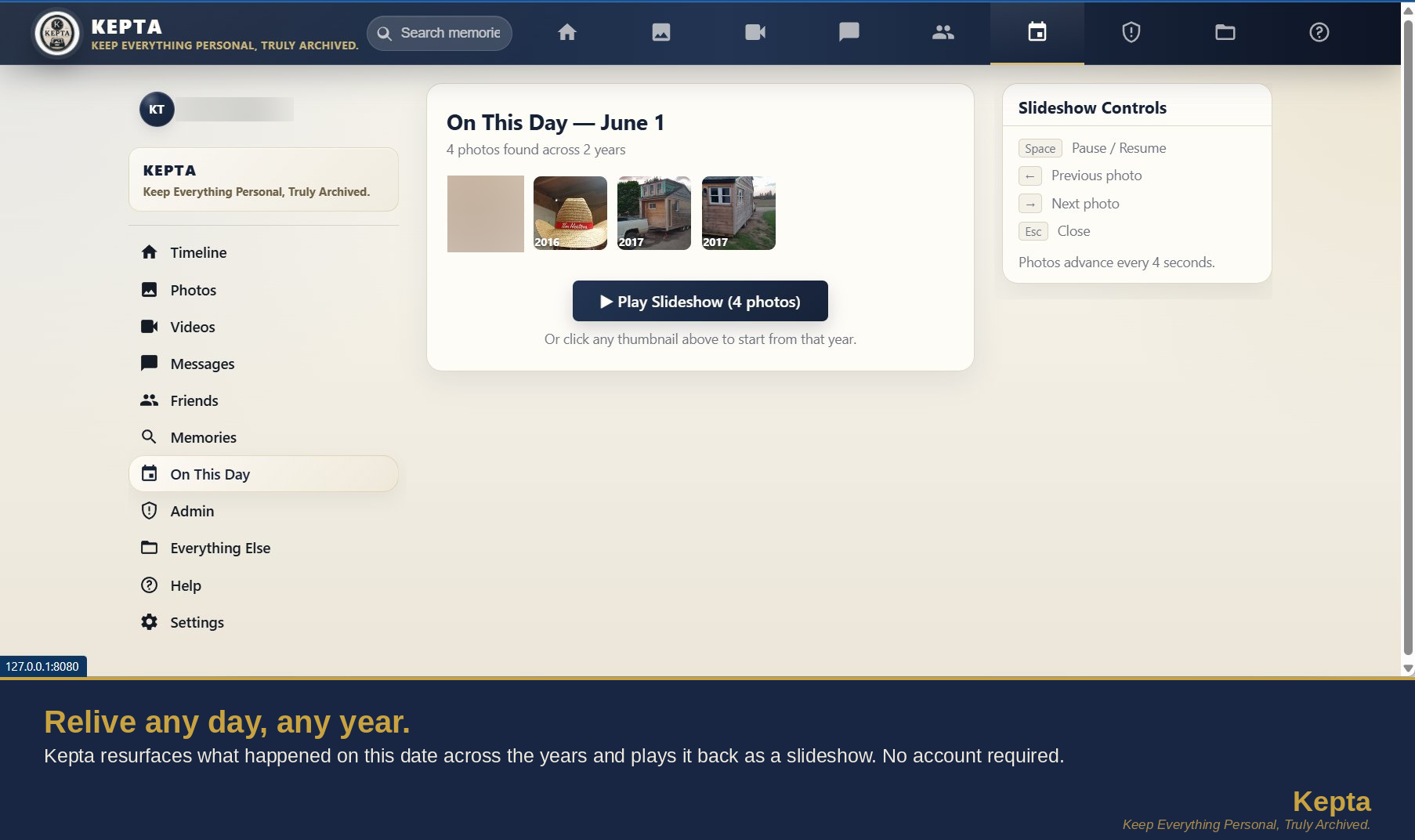
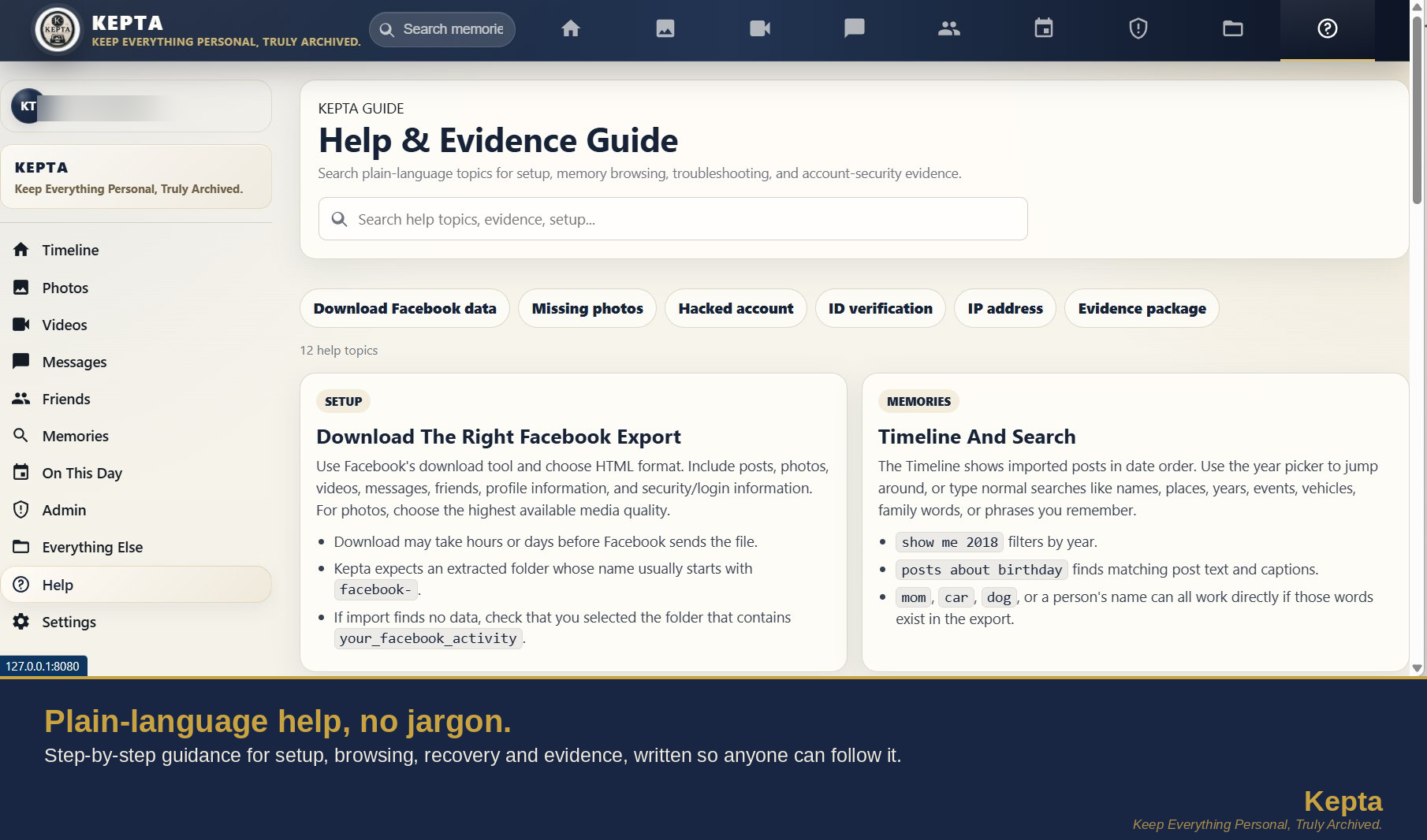
- Memory Search: type what you remember — a year, a person, a place — and find what matters
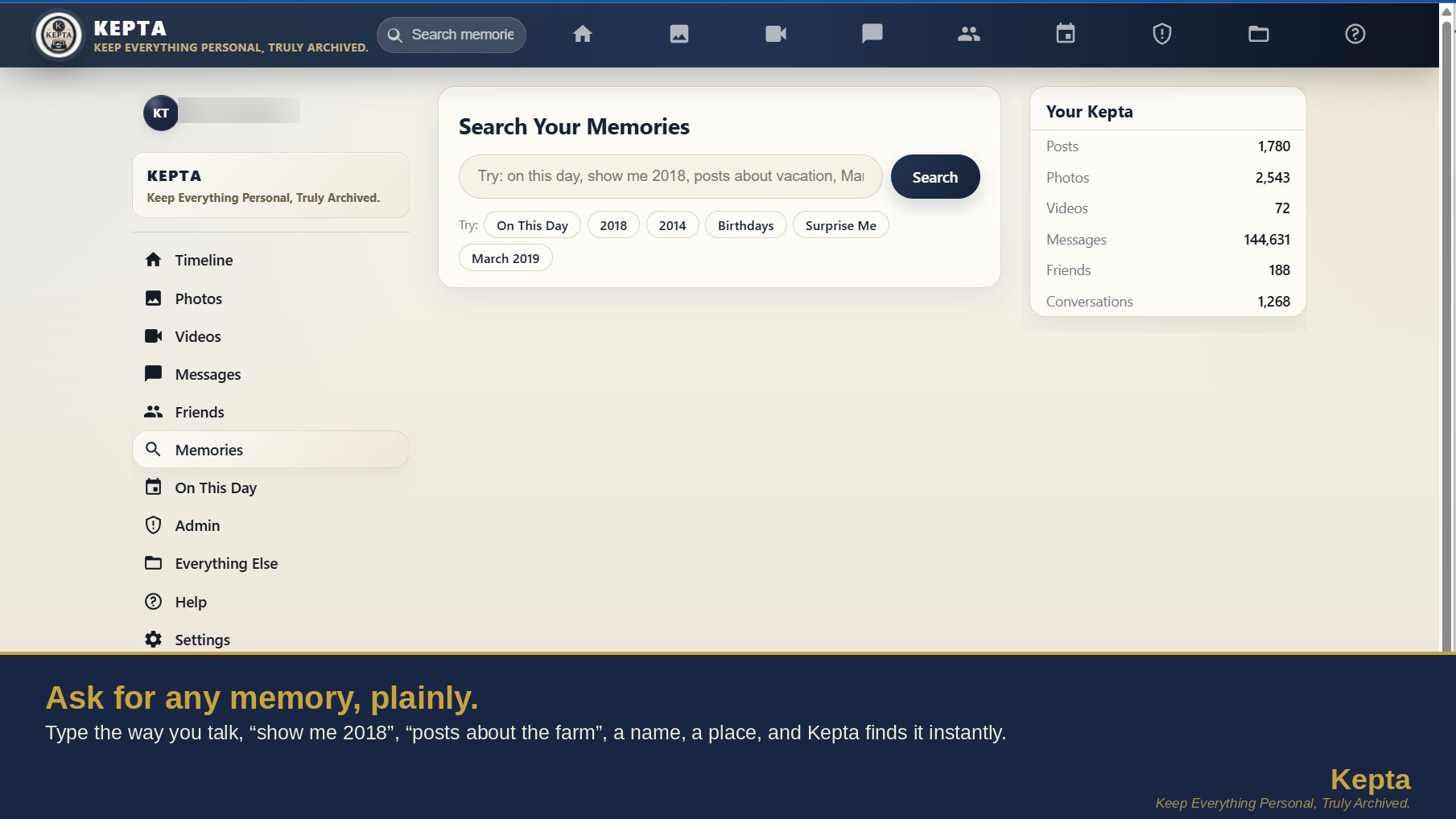
- Admin / Evidence Dashboard: every login, IP address, security event, and recovery attempt — useful if you ever need proof that something happened to your account
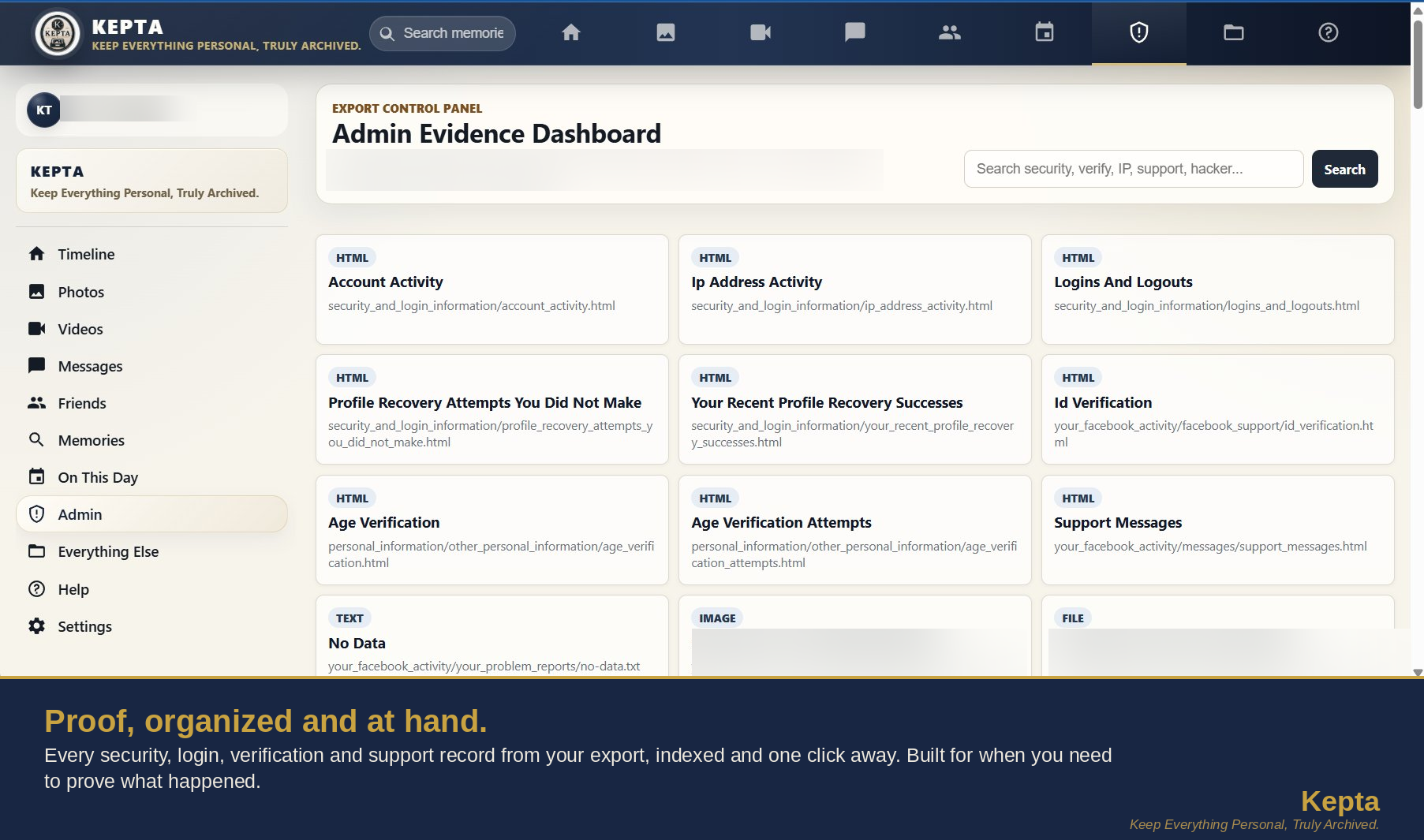
- Help & Evidence Guide: plain-language guide for getting your Facebook export and importing it into the vault
- Everything Else: every file Meta gave you, browsable and searchable in plain folders.
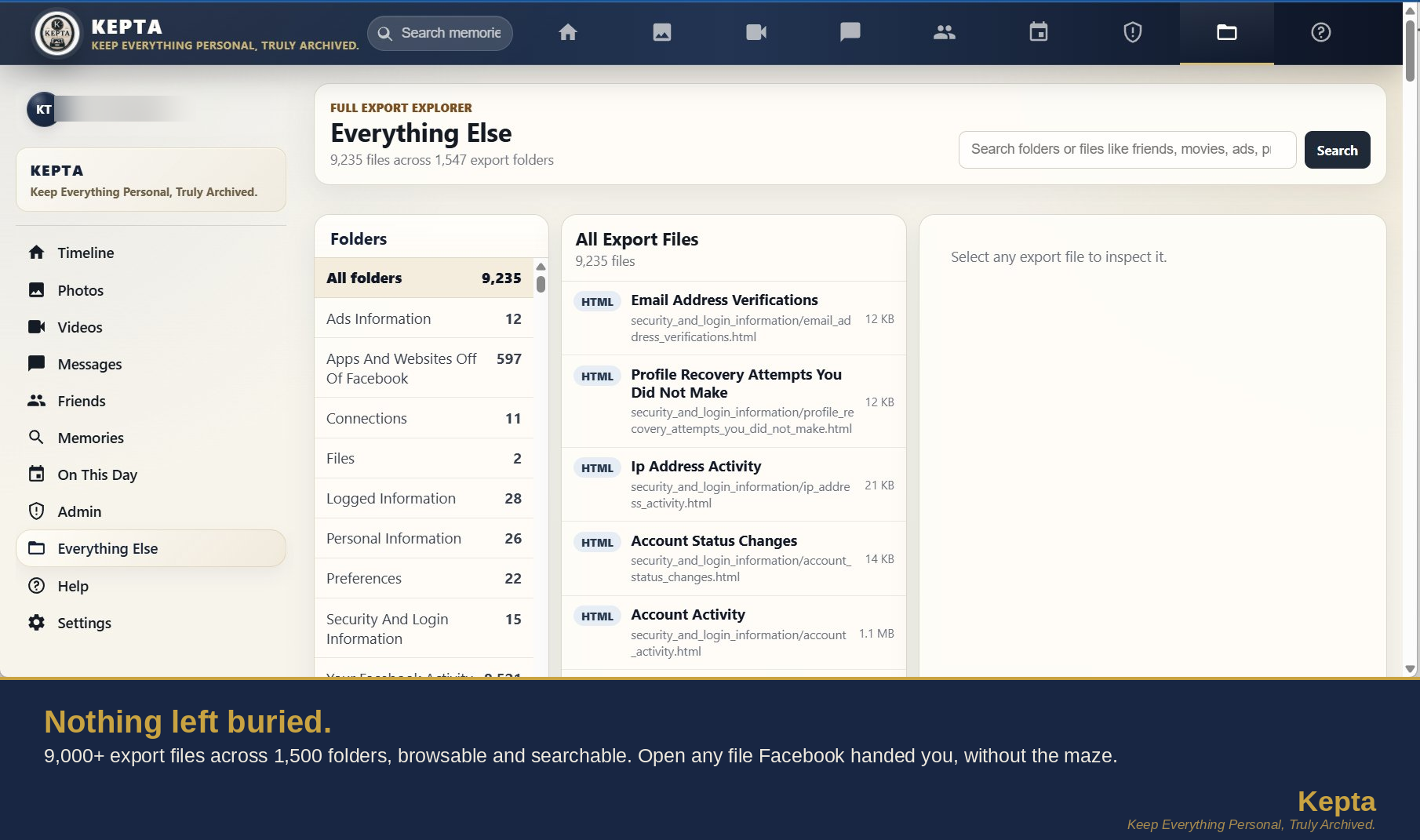
- Settings: optional same-Wi-Fi mobile access so you can browse your archive from your phone without ever touching the cloud
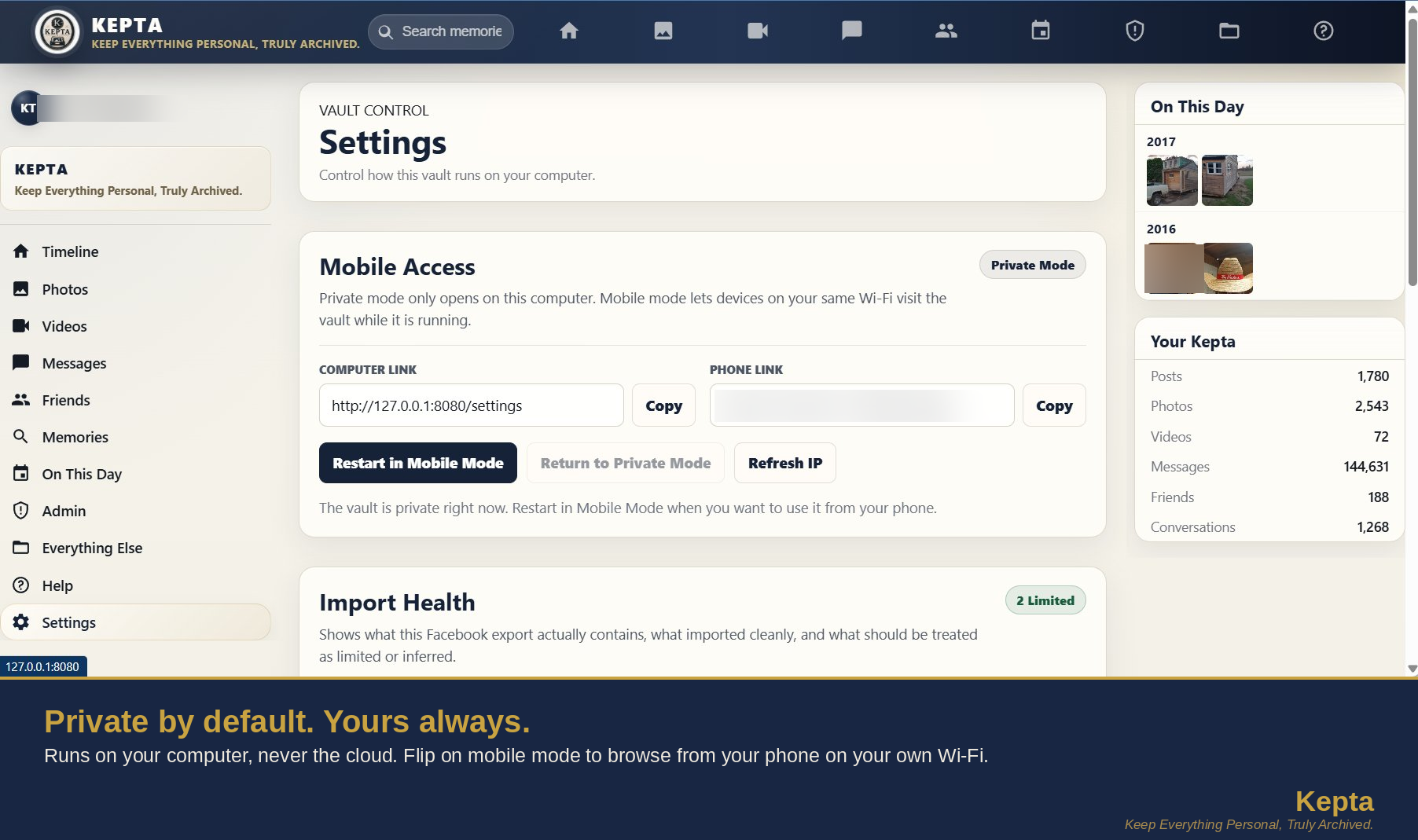
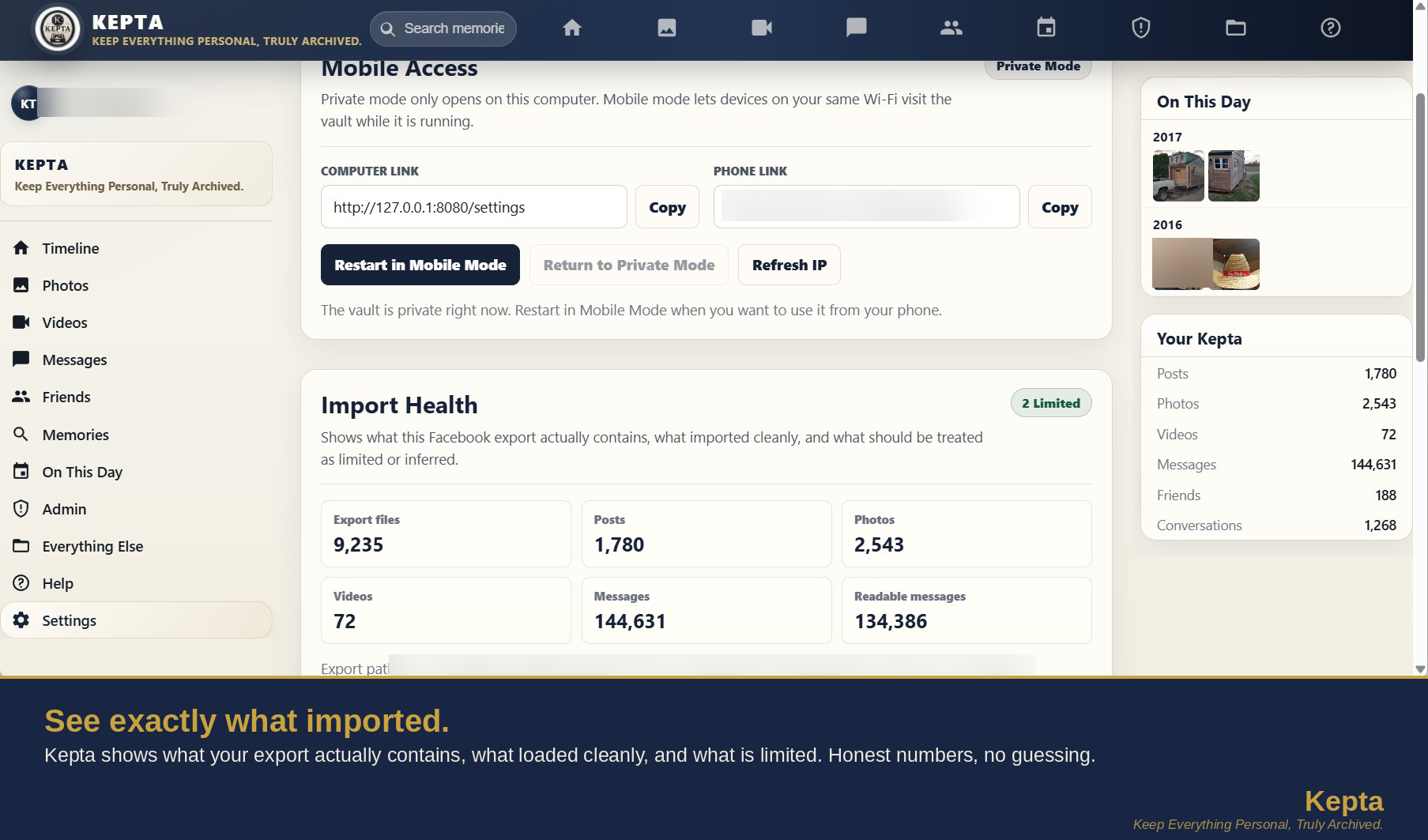
The whole thing runs on your computer. Nothing leaves it. No subscription, no cloud, no terms of service that can be revoked.
Status
KEPTA is live. Version 0.1.0 shipped and is available now — I'm using the vault myself daily to access the conversations Meta locked behind their ban, and now you can too.
Get KEPTA on Gumroad: https://hustlehonest8.gumroad.com/l/kvzxyf — CAD $49.99
What you get: a private archive that runs entirely on your own computer. No subscription, no cloud, no terms of service that can be revoked. Download your Facebook export (HTML format), import it, and you're browsing your own history again — timeline, photos, videos, messages, friends list, all of it.
Requirements: Windows 10/11. Your Facebook data export, requested in HTML format (not JSON) from Facebook's own "Download Your Information" tool.
If you've been through something similar with Meta — disabled account, lost pages, "premium support" that wasn't — get KEPTA before you need it, not after. By the time you need it, the door is already closed on getting it back from Meta. It doesn't have to be closed on having it at all.
Bottom Line
Meta Verified did not help me when I needed it. Four independent analyses — including Meta's own AI — all agree the failure is structural, not personal. Some of what I lost will never come back.
The lesson is the simplest one in this whole story: own your data before you need to recover it. By the time you need it, the door is already closed.
That's why KEPTA exists. That's why this review exists. And that's why, if you're paying $14.99 a month for Meta Verified hoping it will protect you when something goes wrong — you should know now, before you find out the hard way, that it won't.
[Get KEPTA now — CAD $29.99 on Gumroad]
